Antibiogo 2025 post market surveillance results
Routine-use data show 99.7% agreement with microbiologist interpretations and help identify priorities for training and support.

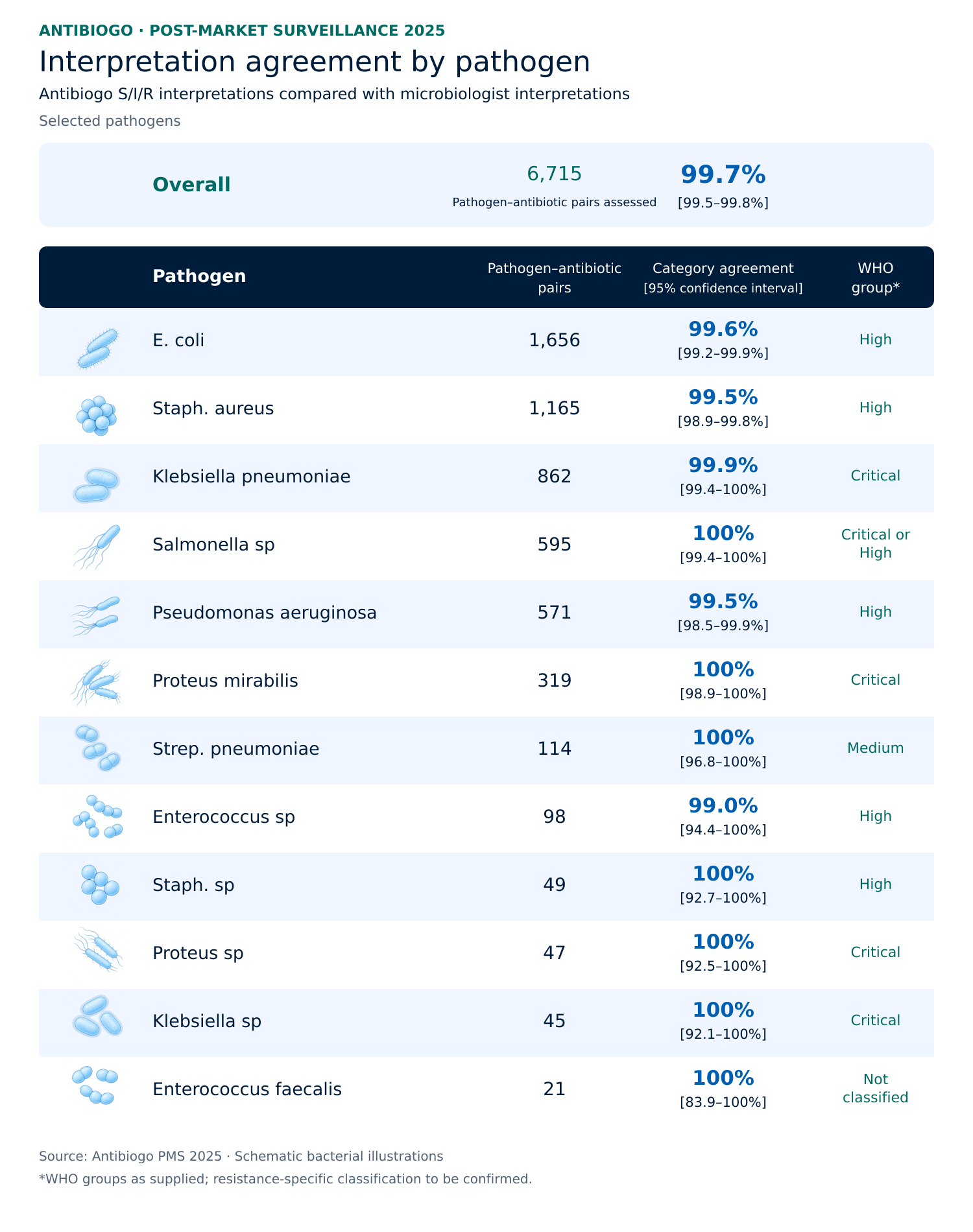
Antibiogo’s 2025 post-market surveillance (PMS)* analysis found 99.7% agreement between its S/I/R** interpretations and those of microbiologists, based on a review of 549 antimicrobial susceptibility testing (AST) bench sheets. The findings provide evidence of the device’s performance in routine use, alongside insights into how laboratory teams use it.
The table below presents interpretation agreement rates for each pathogen included in the analysis:
Data contributed by laboratory teams
In 2025, Antibiogo was routinely used in 14 countries across 31 active sites. Of these, 15 sites in 10 countries voluntarily shared data for PMS. The findings reported here relate to those submitted data.
The material collected included 549 AST bench sheets (representing 12% of the ASTs reported as read with Antibiogo in 2025 by 12 sites included in this analysis), 6,715 Antibiogo-assisted inhibition zone diameter measurements and interpretations, and 219 quality control bench sheets. These records helped assess interpretation agreement and aspects of routine use.
Looking at the quality of routine use
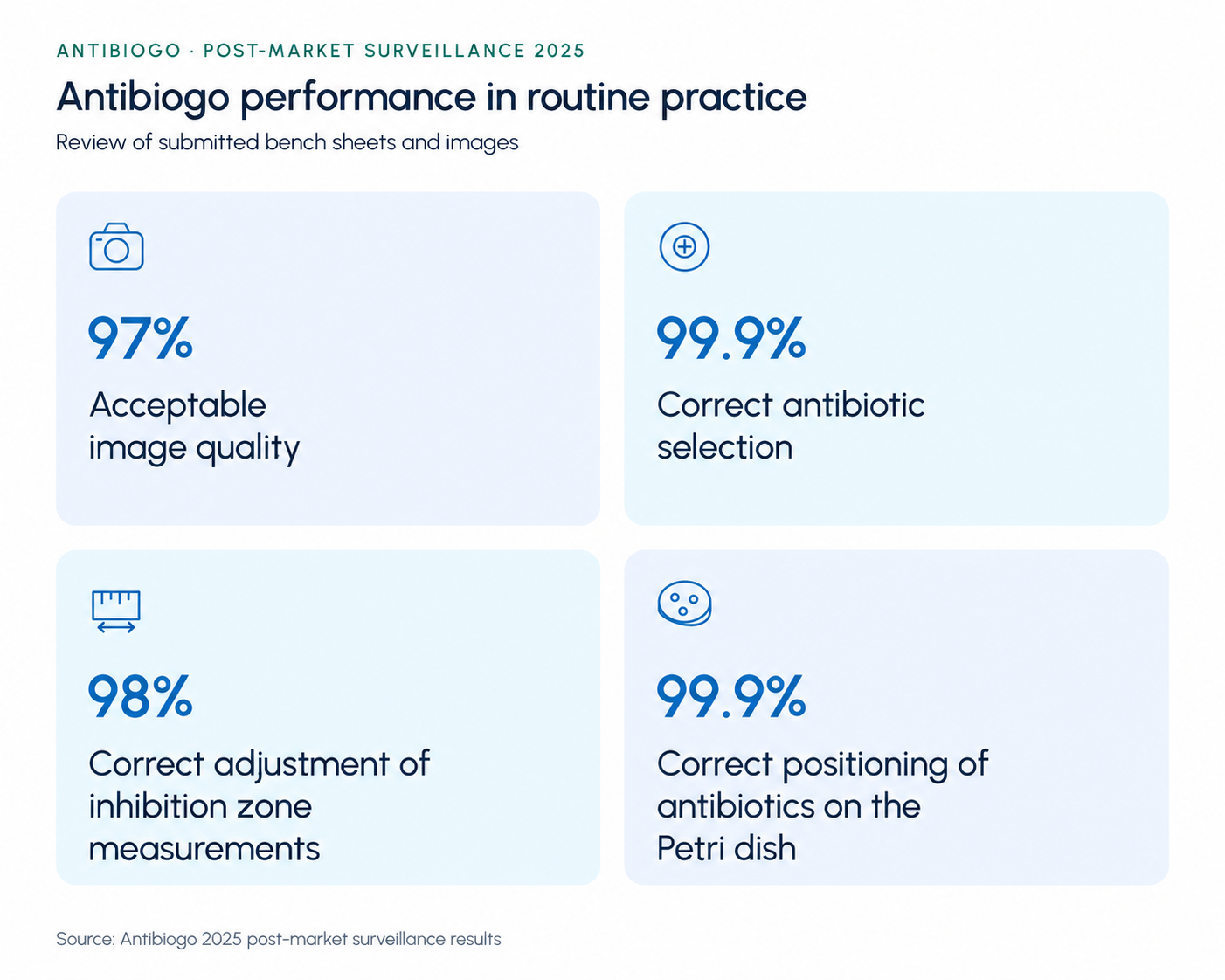
The review of submitted bench sheets and images assessed image quality, antibiotic selection, adjustment of inhibition zone measurements and antibiotic positioning on the Petri dish. The results are shown below.
Identifying where training can help
The review also examined whether users correctly answered questions asked by Antibiogo’s Expert System in order to identify important resistance mechanisms. Among the assessed cases, the reported correct responses were:
- ESBL*** synergy assessment: 137 correct responses (92.6%)
- Detection of inducible MLSB**** resistance using the D-zone test: 39 correct responses (95.1%)
- Assessment of colonies within inhibition zones for Enterococcus/vancomycin: 30 correct responses (88.2%)
These findings help identify training needs and inform improvements to user support tools. They complement the interpretation-agreement result by examining specific aspects of how the device is used.
Monitoring performance throughout the device lifecycle
As a medical device manufacturer, the Antibiogo team conducts PMS as part of its regulatory obligations. The process involves collecting and analysing data from routine use to monitor safety and performance, identify previously unknown risks or limitations, and assess whether the balance of benefits and risks remains favourable. It also helps identify opportunities for improvement and corrective or preventive action when needed.
The 2025 PMS analysis reported no new safety concerns or contraindications. Overall, the findings were consistent with the performance claims described in Antibiogo’s Instructions for Use.
Continuing to build evidence together
PMS depends on the participation of laboratory teams. By continuing to share anonymised AST bench sheets, quality control records and usage data, participating sites help strengthen the evidence supporting Antibiogo and inform its ongoing improvement.
Thank you to the teams who contributed their data in 2025 and to those continuing to support this work.
* Source: Antibiogo PMS report 2025
** S/I/R: categories used to interpret antimicrobial susceptibility. S = susceptible; I = susceptible, increased exposure under EUCAST, or intermediate under CLSI; R = resistant. CLSI also uses a separate category, SDD, meaning “susceptible dose-dependent”
*** ESBL: extended-spectrum beta-lactamase
**** inductible MLSB: macrolides, lincosamides and streptogramin B antibiotics. Inductible MLSB resistance affects these three antibiotic classes
Regulatory information
Device: Antibiogo
Manufacturer: Fondation Médecins Sans Frontières, 34 avenue Jean Jaurès, 75019 Paris, France
Intended purpose: Antibiogo is a stand-alone mobile device software application used in conjunction with a microbiological culture method, intended to aid in the qualitative interpretation of antimicrobial resistance based on EUCAST and CLSI guideline recommendations. Antibiogo is an aid to diagnosis, performing automated interpretation of antimicrobial susceptibility testing using disc diffusion, complemented by minimum inhibitory concentrations (MICs) when available.
Antibiogo is a CE-marked in vitro diagnostic medical device under European Directive 98/79/EC, within the transitional provisions of the European In Vitro Diagnostic Medical Devices Regulation (IVDR).
Before use, carefully read the instructions for use corresponding to the version of Antibiogo being used. Consult the instructions for use.