Antibiogo: AI that supports diagnostics and works in real-world conditions
Ahead of the Nature journal conference, Dr Nada Malou explains how Antibiogo combines targeted AI support, offline use and country control over data

On 14 October 2026, Dr Nada Malou, the microbiologist behind Antibiogo, will speak in London at the Nature journal conference “Reframing Precision Medicine: Innovation to Implementation”, discussing the role of artificial intelligence in infectious diseases. Here, she explains three choices that shape Antibiogo: targeted support for reading antimicrobial susceptibility tests, offline operation and countries’ control over their data.
What exactly does artificial intelligence do in Antibiogo?
We started with a practical need: helping laboratory teams in low- and middle-income countries interpret antimicrobial susceptibility testing (AST), particularly where microbiology expertise is difficult to access. These tests determine a bacterium’s susceptibility to antibiotics and help inform treatment decisions.
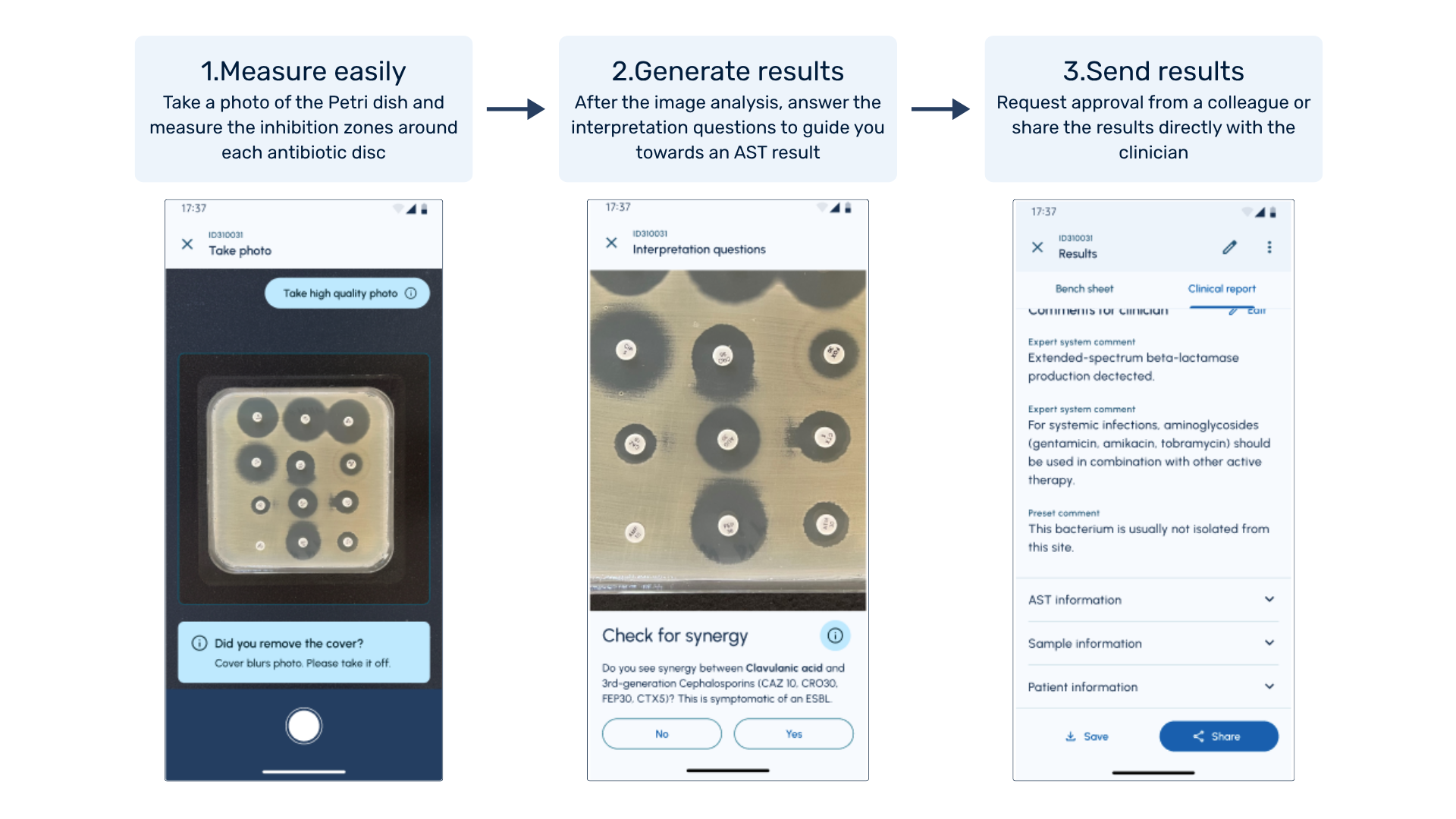
Using a photograph of a Petri dish, AI and image processing help measure the inhibition zones around antibiotic discs. This measurement is semi-automatic: the user checks and adjusts it. An expert system then applies the breakpoints and interpretation rules of the selected standard, EUCAST or CLSI.
AI therefore supports a specific step in the workflow. It assists laboratory professionals, whose role remains central, and provides results to inform clinical judgement. Our goal is to strengthen local capacity and contribute to the appropriate use of antibiotics.
Why is offline operation essential?
A tool must work where teams need it. In some laboratories, internet connectivity is limited or unreliable. If analysis depends on an internet connection, this becomes a barrier to everyday work.
Antibiogo allows users to read and interpret antimicrobial susceptibility tests directly on a smartphone, without an internet connection. Connectivity is still needed to download the app and its updates, and for certain result-sharing functions.
This design combines a scientifically rigorous technology with an approach adapted to field conditions, demonstrated by our usability studies and clinical studies. But the app alone is not enough: implementation includes training and working with teams to integrate it into laboratory practice.
How do we explain to partners their control over their data?
Our principle is clear: countries must retain control over their health data and decide how it is used. Building trust means explaining what this entails in each deployment.
Offline operation enables data to be processed and stored locally on the device. Any national centralisation of results from several laboratories is a separate matter, which is always discussed with the relevant authorities and partners.
If countries choose to do so, the results can also contribute to international surveillance of antimicrobial resistance: integrating them into WHONET can facilitate the preparation of data for GLASS, WHO’s Global Antimicrobial Resistance and Use Surveillance System. This process remains under the control of national authorities, who decide which data to share.
We need to answer straightforward questions: where is the data, who can access it, how is it exported and for what purposes can it be shared? Local storage is one part of the answer; control over data also depends on clearly defined hosting arrangements, access rights and governance rules. These discussions are an integral part of implementing the tool.